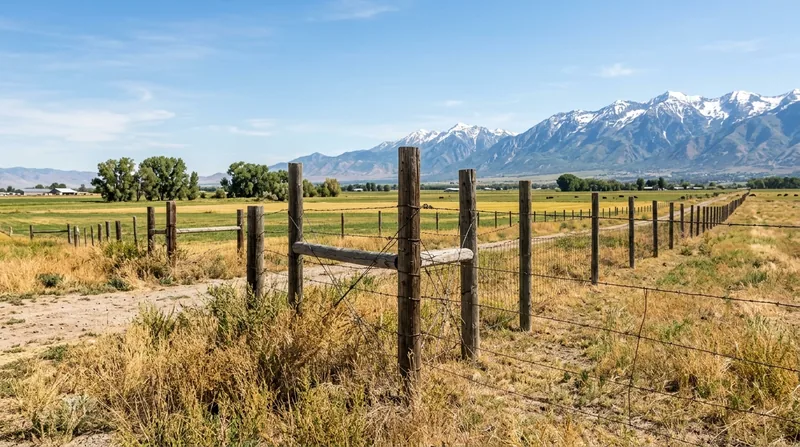




Farm and ranch properties across the Salt Lake City area demand farm fence installation in Salt Lake City that stands up to exposure, livestock pressure, and seasonal ground movement. Whether you're fencing pasture, containing livestock, or securing a larger property line, the soil conditions and frost dynamics of the Greater Salt Lake City region require posts set deep and solid. We build farm and ranch fences that stay tight through winter snow load and summer heat cycles, using materials and methods proven on working land. Since 2012, we've installed and repaired split rail, pipe, no-climb horse fence, and barbed wire fencing across Salt Lake City, West Jordan, Sandy, South Jordan, and surrounding communities. Call (385) 354-7337 for a free estimate, or read on to understand what makes a farm fence last.
Why Farm & Ranch Fencing Matters in Salt Lake City
A working fence on acreage is not the same as a residential privacy line. Farm and ranch fencing carries livestock, marks property boundaries across open ground, and must survive ground heave, freeze-thaw cycles, and the constant pressure of animals and weather. In Salt Lake City and the surrounding communities, property lines often cross valley terrain where soil composition and drainage patterns shift. Posts that are set too shallow or in inadequate concrete will shift, sag, and fail within a few seasons, costing you in repairs and lost containment.
- Posts set below frost depth and in solid concrete prevent heave and keep fence lines square through winter.
- Proper post spacing (typically 6 to 8 feet for ranch fence, closer for horse containment) distributes load and reduces sag.
- Material choice (wood, vinyl, pipe, or wire) depends on livestock type, visibility needs, and long-term maintenance tolerance.
- Anti-sag bracing on longer runs and proper rail tension keep the fence functional and safe for animals.
Getting the foundation right from the start is the difference between a fence that serves your property for years and one that becomes a maintenance headache.
Key info: Before any digging, Utah law requires a utility locate through 811. Call 811 or visit call811.com to mark gas, water, electric, and telecommunications lines on your property. This is a free service and takes 2 to 3 business days. Do not skip this step, even on acreage.
How We Install Farm & Ranch Fencing in Salt Lake City
Our process starts with understanding your land, your animals (if any), and your boundary. We work from your existing survey or the line you identify, locate utilities, and plan post placement to account for terrain. On acreage near Salt Lake City and surrounding areas, we set posts past surface clay and below frost depth so your fence line stays tight regardless of ground movement. Every rail is tensioned, every gate swings freely, and every connection is made to last.
- Schedule a free site visit and estimate at (385) 354-7337 or request an estimate online.
- We locate utilities via 811 and confirm property lines with you before any work begins.
- Posts are dug, set in concrete below frost depth, and allowed to cure before rails are installed.
- Rails, boards, or wire are attached with proper tension and bracing to prevent sag and movement.
- Gates are hung, tested for swing and latch, and fitted with self-closing or self-latching hardware if requested.
- We walk the completed line with you and address any final adjustments before we leave.
This deliberate pace prevents costly mistakes and ensures every fence we build is ready for real work.
Local example: A ranch property in South Jordan with clay-heavy soil and 200 linear feet of pasture fencing typically takes 3 to 5 business days from post holes to finished line, depending on weather and ground conditions. Posts are set 24 to 36 inches deep to clear the frost line and ensure stability year-round.
Farm & Ranch Fencing Methods and Materials
| Approach | Description | Best for |
|---|---|---|
| Split Rail Fence | Wood rails mortised into posts, typically 3 rails high, pressure-treated or cedar. | Property boundaries, visual appeal, moderate containment, lower traffic livestock. |
| No-Climb Horse Fence | Vinyl or wire mesh in a grid pattern, attached to posts with no horizontal rails a horse can grip or climb. | Horse pastures, high-energy livestock, safety-critical containment, minimal maintenance. |
| Pipe Fence | Steel or aluminum pipe welded or bolted to posts, galvanized or powder-coated for rust resistance. | Heavy livestock, high-traffic areas, long-term durability, minimal seasonal maintenance. |
| Barbed Wire Fence | Wire strung tight between posts with proper spacing and tension bands, typically 4 to 6 strands. | Cattle, large acreage, perimeter containment, lowest upfront cost, requires regular tension maintenance. |
| Combination Systems | Split rail or pipe with wire or mesh infill, combining aesthetics, durability, and containment strength. | Mixed-use properties, multi-species grazing, visibility plus security, long-term asset value. |
Each method has distinct labor, material, and maintenance profiles. We help you match the fence type to your animals, terrain, and budget.
Farm & Ranch Fencing Cost in Salt Lake City: What to Expect
Farm and ranch fencing cost in Salt Lake City ranges widely depending on material, terrain, and post depth. Split rail and barbed wire installations typically start at $13 to $18 per linear foot, while no-climb horse fence and pipe fence run $18 to $35 per linear foot or higher. Combination systems and specialty gates add to the total. A 200-foot pasture fence in Sandy or South Jordan, with posts set below frost depth and proper bracing, typically costs between $2,600 and $7,000 depending on material choice and ground conditions.
Factors that affect your final cost include post depth (deeper posts in clay or unstable soil cost more labor), terrain (sloped or rocky ground requires more time and equipment), material choice (pressure-treated wood costs less than pipe; vinyl costs more than wire), and gate complexity (a simple swing gate costs less than an automatic driveway gate). Getting 2 to 3 estimates from local installers is smart practice. It helps you understand the real cost drivers for your specific property and ensures you're comparing apples to apples.
For a detailed breakdown of what drives farm fence pricing and to see estimates for your acreage, visit our pricing page or call (385) 354-7337 for a free on-site estimate.
Farm & Ranch Fencing Near Me: What Salt Lake City Homeowners Should Know
When you're hiring someone to install or repair farm fencing on your Salt Lake City property, a few practical steps protect your investment and your peace of mind. First, confirm that the contractor carries full general liability and workers' compensation insurance and can provide a certificate of insurance on request. Second, understand that Utah issues fencing-specific contractor classifications through the Division of Professional Licensing; verify any contractor's licensing directly with the Division and confirm whether your project requires a permit by contacting your local city or county building department. Third, get estimates from at least two local installers who have experience with acreage and ground conditions in your area. Finally, ask for references from customers with similar properties and check them.
We are fully insured and have installed farm and ranch fences across Salt Lake City, West Valley City, West Jordan, Sandy, South Jordan, Millcreek, Taylorsville, and surrounding communities since 2012. We hold AFA Member Installer status through the American Fence Association. When you call us for an estimate, we listen to your land, your animals, and your goals before we recommend a fence type or material. We're happy to discuss insurance, permitting, and any concerns specific to your property.
Farm & Ranch Fencing in Salt Lake City: Pricing Guide
| Service | Price | Details |
|---|---|---|
| Split Rail Fence Installation | Starting at $13/ft | Pressure-treated or cedar rails mortised into posts set below frost depth; cost increases with post spacing and rail quality |
| No-Climb Horse Fence Installation | Starting at $22/ft | Vinyl or wire mesh grid attached to posts with self-closing gates; higher cost reflects safety and durability for equine containment |
| Pipe Fence Installation | Starting at $24/ft | Galvanized or powder-coated steel or aluminum pipe welded to posts; cost varies by pipe diameter, weld complexity, and finish |
| Barbed Wire Fence Installation | Starting at $8/ft | Four to six strands of barbed wire strung tight with proper tension bands; lowest upfront cost, requires regular maintenance |
| Gates and Automatic Openers | From $400 to $2,000+ | Swing gates, cantilever gates, and automatic driveway gate operators; cost depends on gate type, width, and automation features |
| Free Estimate | No charge | On-site visit, 24-hour response, no obligation to book; includes utility locate coordination and site assessment |
Indicative pricing, the exact cost depends on square footage, finish, and site access. Free personalized estimate within 24h at (385) 354-7337.


